In Aesop’s fable of the tortoise and the hare, the hare was so confident that he would win their race—and so tired from running hard—that the hare took a nap in the middle of the race. Meanwhile, the slow and steady tortoise overtook the sleeping hare, passed him by, and easily won.
What if we were more like the tortoise than the hare? Could slowing down help us go the distance in life and ministry? I appreciate this article by Emily Lund, first published in Faith & Leadership, and reprinted here with permission.
Could slowing down help us both recharge and build endurance?
When runners train for a race, they are told to spend most of their time preparing at a slower pace to help them speed up when needed. The strategy offers important lessons for how we approach our work and life, writes the director of communications for Leadership Education at Duke Divinity.
by Emily Lund, Director of Communications, Leadership Education at Duke Divinity
I didn’t grow up playing sports, so when I first started running in my early 20s, it was mainly because I wanted to try something athletic that required very little equipment and hand-eye coordination. As someone entering the wide world of running without a coach or team to advise me, I mostly relied on the internet as a guide.
I learned so much. Who knew that different kinds of running shoes were better for different kinds of feet? Or that if you’re running far enough, you should eat not only before and after but during your run?
One of the most valuable—and most counterintuitive—pieces of guidance I found was this: most of your runs should be slow.
Slow?
Isn’t the whole point of running to, I don’t know, run? Not jog, shuffle, fast-walk?
But this is in fact what the experts say: a majority of your runs should be significantly below your race pace. In fact, something called 80/20 training refers to a style of preparation — used by recreational and elite runners alike — in which 80% of running workouts are done at an easy level of intensity, with just 20% done at a hard pace. Why? Among other factors, “easy runs train the cardio and respiratory systems to work more efficiently, allowing you to run with less effort during higher-intensity runs.”
As Runners World puts it, “All the evidence points to the fact that slowing down your pace for much (if not all) of your training can actually make you run faster in the long-term.”
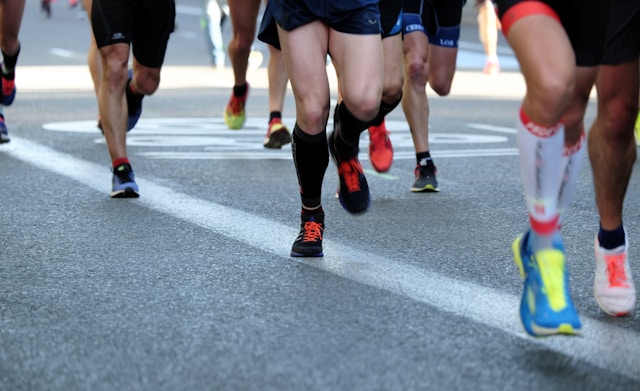
Several years into making my running habit a more serious one, I still struggle with this. How can I really prepare to go at a faster speed if I’m not actually going that speed most of the time? What if I just want to go faster now? Maybe slowing down is a strategy that works for other people—but does it work for me?
Now look back at the list of questions in the paragraph above and raise your hand if you’ve ever asked yourself similar questions regarding other areas of your life—your career, your ministry work, etc. It’s easy to nod our heads and say amen to all the wisdom around Sabbath and self-care, but in reality, do we live our lives as though rest is something that’s not for us?
To be sure, rest is not always an option. As my colleague Prince Rivers reminds us, “Some people are busy because their survival demands it.” This kind of busyness is tied up in “doing what is required to care for one’s family.”
But Rivers also highlights a word of warning from Thomas Merton, who wrote:
There is a pervasive form of modern violence to which the idealist … most easily succumbs: activism and over-work. The rush and pressure of modern life are a form, perhaps the most common form, of its innate violence.
This is not the kind of overwork that survival demands. Instead, Rivers notes, Merton “makes a specific reference to ‘the idealist.’ This is the person who is changing the world, championing a cause or fighting the good fight.”
Many of us can relate to this idealist. Do we think that we simply can’t slow down, because the work is too important, the cause too great? Do the places where we work and worship convey, explicitly or implicitly, that this kind of slowing is not ideal? If we slowed down, would we ever be able to speed back up? Would others overtake us?
As with all metaphors, this one has its limits, and I want to be clear that in running, slowing down can be a valuable tool for improving the overall pace. In the context of our rhythms of work, however, slowing down should not be viewed simply as a means to be more efficient once we do speed back up again. As seminary professor and psychologist Chanequa Walker-Barnes writes, when it comes to rest and self-care, “deeply and faithfully loving and caring for [ourselves] is enough,” apart from any added productivity that a time of recharging might bring.
What interests me about this particular running image, though, is that it has something to say to us specifically about slowing down—not stopping, not taking up another sport entirely, just slowing.
There are certainly times to stop, to kick off your shoes and take a shower and a long nap. Yet for those of us who don’t necessarily need to do that at the moment, what might it look like to still be moving, but at what runner types refer to as a conversational pace, “a pace you should be able to hold a full conversation at—not just one or two gasped words”? How might this help us build up the endurance we need as we move through our work and world? And how might we advocate for this kind of pace whenever we can?





 When You Work for the Church
I’d love to hear from you: