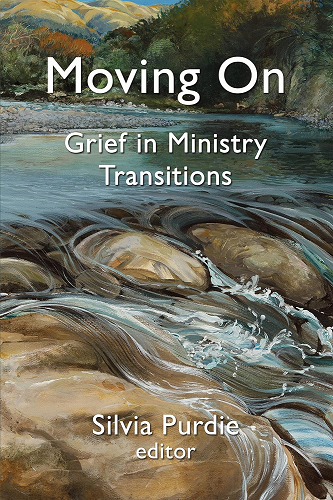
I’ve written on grief, I’ve shared posts on difficult ministry transitions, and today I’m introducing a resource that addresses both: Moving On: Grief in Ministry Transitions edited by Silvia Purdie (Philip Garside Books, 2022).
Moving On includes many stories of ministry transitions, poems, prayers, and tools for grieving and moving on. While Silvia Purdie lives in Aotearoa New Zealand, and her context clearly informs her work, Moving On has much to offer readers in North America too.
I appreciated her book so much that I asked for permission to reprint an excerpt that highlights five key ideas for grief recovery. Permission was gladly granted, and the excerpt appears below. Moving On is available as an ebook from Amazon and from the publisher Philip Garside Books.
The Only Way Out Is Through
by Silvia Purdie
used by permission
Grief becomes more and more simple.
Initially, loss is so complex,
so many aspects to the changed relationship,
so many things said and unsaid, done or undone.
The work of grief attends gradually to these entanglements
until only pain remains,
like a great rock, wordless and heavy,
which we carry around for ages
until we try putting it down for a while
and maybe it finds a place to rest
where we can visit it occasionally.
The only way out is through. Grief for the end of a ministry will take whatever it takes. For those of us immersed in the Christian story, the process of recovery will lead us through crucifixion before we see the light of resurrection dawn. I would like to highlight five key ideas, some of them in a paradoxical relationship with each other, that have, for me, formed my recovery.
1. Rest
My first call to those dealing with the grief of a ministry is to rest. Rest is not an optional extra of grief. The brain and the body must have space to uncurl. The soul must breathe if it is to heal. Those of us in ministry know that rest is God-ordained, even commanded, and we encourage others to rest, but resting ourselves is another matter. Why is it so hard for us to give ourselves permission to rest? I have set myself to the task of learning to rest, to let a whole day go by without achieving anything, to read purely for the joy of it, to watch trash TV, to blob about in my pyjamas till lunchtime, to amble slowly instead of ‘going for a walk,’ Don’t rush in to new things. Let yourself grieve.
2. Own it
Secondly the challenge is to fully accept responsibility for yourself. No one else can get you through this. Some people can help, but most people won’t know how. All my emotions and reactions are mine. I am not a victim, I do not need rescuing. I can hold my own pain and endure it. I can forgive, when I’m ready.
3. Surrender
Once we hold our grief fully, we can give it away to the only One who wants it: Christ. If only this was quick or easy. The grieving process is a gentle relinquishing, bit by bit, finding my way into each aspect of loss, entering it and turning it over to God. The spiky bits are hardest, things we find unacceptable, a sharp thread of bitterness wound around a remembered conversation, a reaction I am ashamed of. Nothing is unacceptable to God. He’ll have it all, and make of it something beautiful, in time, through surrender.
4. Get in the Flow
Spirit wounds require Spirit healing. Betrayal, disappointment, abuse or rejection in the Body of Christ cause grief that only Jesus himself can heal. But spiritual grief, especially for those who minister in the name of Christ, inserts pain into the very things that should bring peace. This requires new ways to connect with God; it needs ancient traditions, soul friends and wise counsel. Go out of your way to place yourself in the flow of God. Ask for prayer from people you trust. Enter worship as a nobody, treasured by God alone.
5. Work it Out
A vital component to resolving grief is finding a way to drag it out into the light, finding a form of memorial. Communities build statues, churches write names on a board, families plant a tree. Me, I write and find safe ways to tell my story. I printed some photos from my previous ministry in order to celebrate wonderful moments. How might you honour in a tangible way what you had and what you have lost? Name your experience. Tell your story.
These exist in paradox. Grief is work and it is rest, it is holding and it is letting go. Psychologists talk about ‘dual process’ to describe how we turn back toward loss and turn forward away from it. Christians talk about it as the cruciform path, sharing the cross of Christ in order to share in his resurrection. Ultimately it is not ‘recovery’ at all, as though the purpose was to regain what we have lost—certainly not. The purpose is formation, maturity, growing up into our full stature in Christ, knowing him that we might ‘gain Christ.’ For this everything is gladly lost (Philippians 3:8).

Silvia Purdie lives in Upper Hutt, Aotearoa New Zealand, and is a Presbyterian minister, supervisor and therapist, and climate and sustainability consultant. Her most recent book is Moving On: Grief in Ministry Transition (Philip Garside Books, 2022). For more information, please see her website. which is a wonderful mix of worship resources, counselling information, climate theology, and much more.







 When You Work for the Church
I’d love to hear from you: