Last week I had a wonderful time at the binational gathering of the Mennonite Camping Association. What a privilege to meet with such a dedicated and fun group of people from camps across Canada and the United States! We walked, hiked, gathered for worship and workshops, enjoyed delicious meals and snacks, and connected with one another at beautiful Camp Squeah in Hope, B.C.
I had been invited to offer four keynote sessions on soul care and nurture for camp staff. And since my articles on self-care are among the most popular on When You Work for the Church, I’m sharing my outline below along with the group’s ideas for self-care at work and how good self-care can be good community care. Their responses give a window on the world of camp ministry and some great ideas on self-care for anyone, so please read on.
Soul Care and Remembering God’s Wonders

Key Scripture: Psalm 105:1-5, the story of a people journeying together, my story, your story
Spiritual Practice: Gratitude circle
As the months pass and you fill your journal with blessings, an inner shift in your reality will occur. Soon you will be delighted to discover how content and hopeful you are feeling. – Sarah Ban Breathnach
Soul Care: When the Journey Is Too Great for Us

Key Scripture: 1 Kings 19:1-18, Elijah’s story of burnout and recovery
Spiritual Practice: Lectio Divina
Soul Care and the Rhythm of Creation

Key Scripture: Genesis 1:1-2:3; Exodus 20:8-11; soul-care as part of the rhythm of creation
Luke 4:16; Mark 6:31-32; and other gospel texts on Jesus and soul-care
Spiritual Practice: Outdoor Guided Reflection booklet
Small Group Discussion: In what way is soul care part of your work life?
- Moving the office out of the bedroom into a separate room at home, and closing the door at the end of the day.
- Using my treadmill while answering emails.
- Going into the forest by myself before going on with the rest of my day.
- Walking to work.
- Setting boundaries. Making myself available by phone only at certain times. Going outside to take a phone call. Being accessible all the time is not good.
- Realizing emails are not urgent. They can wait. Turn off alerts for emails.
- Always stop work for family.
- Take a brain break. Get fresh air. Get a change of scenery. Walk around. Get your steps in. Take a nap. Drink some water. Keep a water bottle handy.
- Slow down.
- Make lists – not of absolutely everything at once, but limited lists that can reasonably be accomplished.
- Say no, which can be a challenge when you love the work, when you feel the burden of all that needs to be done. Camp work never stops. Things keep breaking down. When one group is leaviing, the next group is coming in.
- Take time to be alone, e.g., going into town for camp errands alone and not always with others.
- Get away from the office, away from interruptions, e.g., to a coffee shop or for a drive.
- Know your red flags, e.g., if you’re snapping at people.
- Know the rhythms of the different seasons.
- Give permission for staff to take time for appointments.
- We have a pie rule for staff—if you call another staff person for something urgent after hours, you need to give a homemade pie.
- As a leader, I help others take care of themselves.
- Choose to see the souls of those you work with as more important than the work.
- Realize that self-care is community care. We can share the load. When things seem overwhelming, we can help each other out.
- Practice community, e.g., having lunch together, foosball at afternoon break.
- Value connecting day by day—not all computer work, but actually phoning/talking with someone.
Soul Care: From the Mountain Top to the Daily Grind
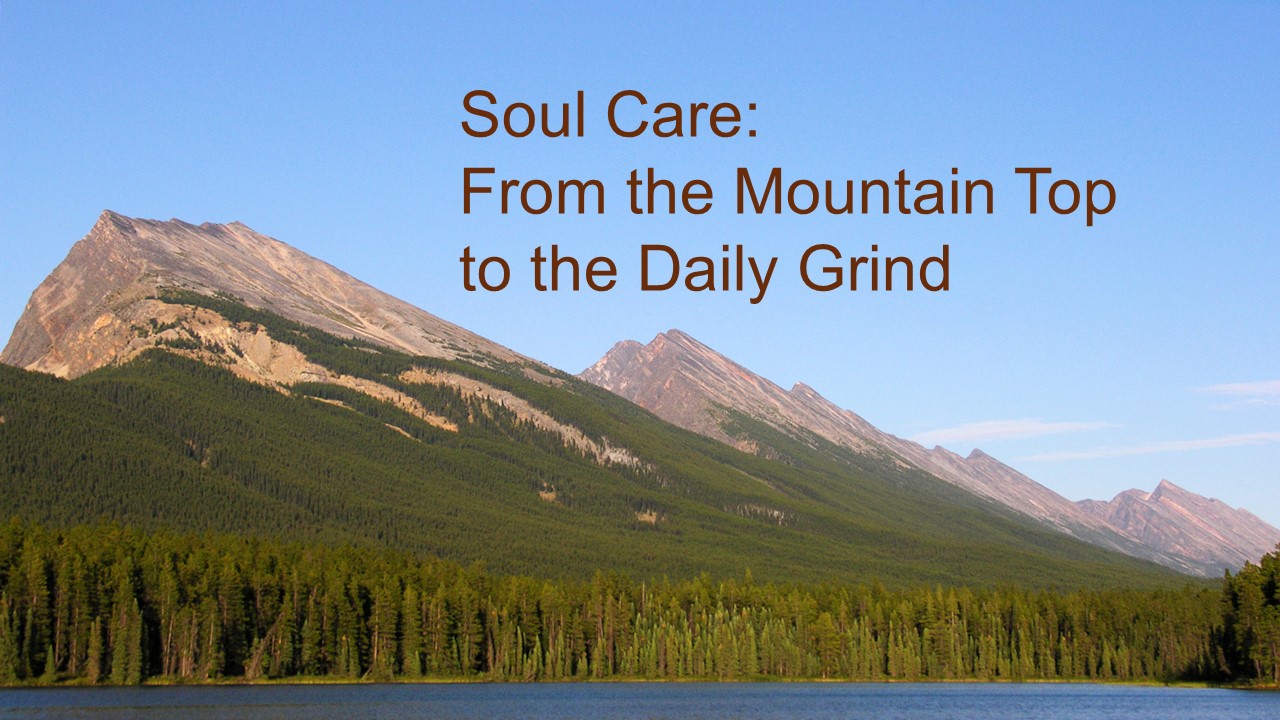
Key Scripture: Matthew 17:1-20, just as Jesus and his disciples descend from the mountain top to the confusion of the crowd below, we can’t live on mountain-top experiences alone
Spiritual Practice: Examen of Consciousness: Prayer of Reflection
Small Group Discussion: In what way is soul care good for you personally and good community care?
- Self-care and community care go hand in hand.
- Self-care is not a competition, but for community as a whole.
- When our self-care is lacking, our community feels it. We may find it more difficult to support our summer staff. And when our community is in trouble, it may be harder to find self-care, because who can we turn to?
- When we need help, we sometimes end up making other people busier.
- It’s important to know how to delegate and tap resources from your staff and others.
- Is our attitude being “burned out for Jesus” or learning/needing not to be indispensable?
- Bringing in people with knowledge or experience.
- How do we practice what we preach about self-care?
- Be intentional about taking sabbaticals and being able to give staff time off.
- Developing sabbatical policy includes educating others: time for renewal contributes to longevity, good energy, fresh ideas that benefit the person and the community.
Thank you, Mennonite Camping Association, for the opportunity to offer some teaching on soul care, to engage in spiritual practices together, and to learn from you.








 When You Work for the Church
Leave a Reply to schroedereh Cancel reply