As a scholar and professor of hermeneutics, Dr. Gary Yamasaki always appreciated a deep dive into the biblical text. And when his students had questions about bibilical interpretation and women in ministry, he put together a detailed summary of the work of Dr. Catherine Clark Kroeger.
As a meticulous scholar himself, he appreciated her meticulous work on 1 Timothy 2:11–15. As my always supportive husband and one who deeply loved the church, he encouraged me as a pastor, and more broadly encouraged both men and women in ministry. In that spirit and in his honour, I’m sharing a somewhat less detailed summary of his summary below. Be forewarned, it’s still what I consider a deep dive into the biblical text with a fair bit of Greek grammar—but well worth thinking through!
I Suffer Not a Woman:
Re-Thinking 1 Timothy 2:11–15
by Gary Yamasaki
These words attributed to the apostle Paul have been used for centuries to bar women from leadership positions in the church:
I do not permit a woman
to teach or to have authority over a man;
she is to keep silent.
—1 Timothy 2:12
However, New Testament scholar and professor Catherine Clark Kroeger makes a compelling case that these words were never intended to silence women. Rightly understood in their historical, religious, cultural, and literary context, they were an exhortation against heretical teaching spreading among some of the women in the church at Ephesus.
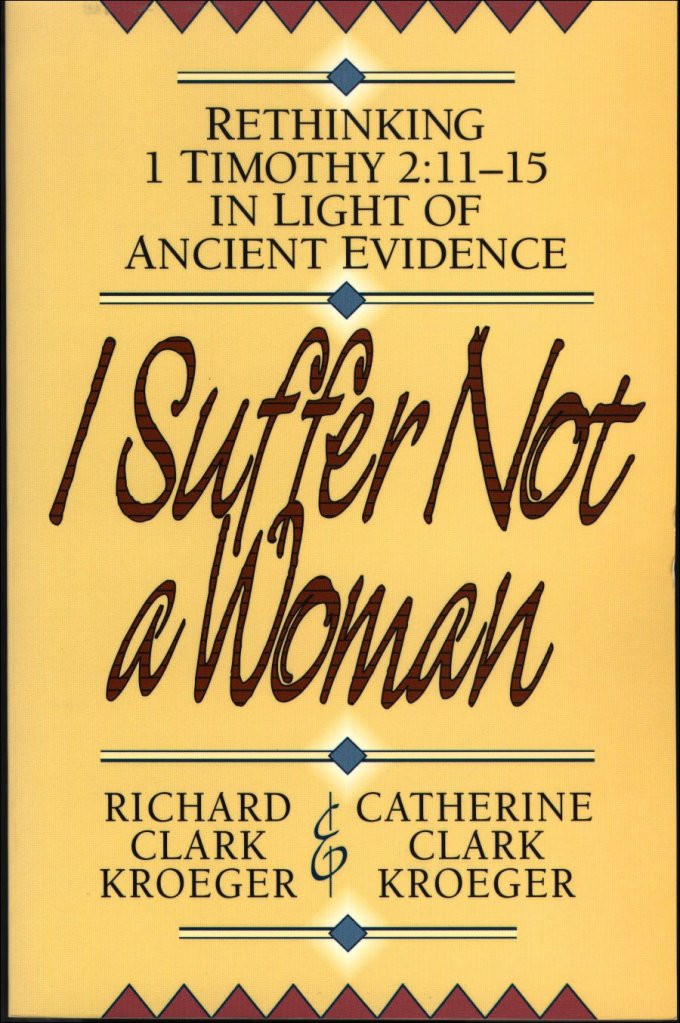
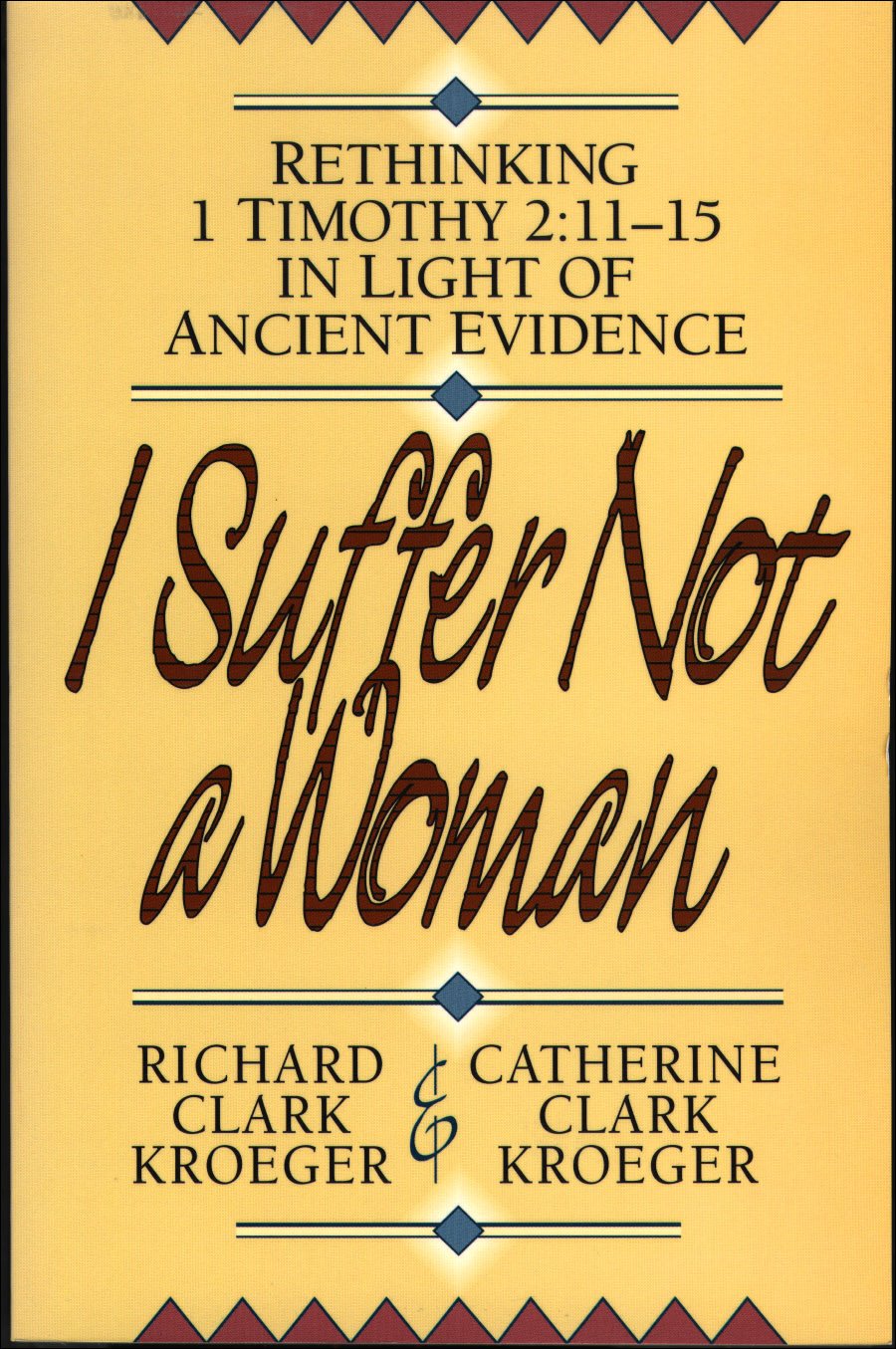
Below are some of the main points from Catherine Clark Kroeger and Richard Clark Kroeger’s 250-page book: I Suffer Not a Woman: Rethinking 1 Timothy 2:11–15 in Light of Ancient Evidence (Baker, 1992).
Heretical Teaching is a major theme of 1 Timothy
The letter of 1 Timothy depicts the church in Ephesus under siege by heretical teaching that led to bitter disputes. This is clearly evident in the exhortation at the start of the letter:
I urge you, as I did when I was on my way to Macedonia, to remain in Ephesus so that you may instruct certain people not to teach different teachings and not to occupy themselves with myths and endless genealogies that promote speculations.
—1 Timothy 1:3–4
The details of this heretical doctrine are not given, but the reference to “genealogies” suggests that it involved the issue of “origins and first causes” prominent in the surrounding pagan religions that developed long genealogies to trace a person’s history to their origin.
1 Timothy refuted the heretical teaching of Gnosticism
Gnosticism first arose in Egypt—likely in the second century BC—then spread from there. By the late first century, Cerinthus brought a well-developed form of Gnosticism to Ephesus, but certain Gnostic beliefs may well have spread as far as Ephesus years earlier, perhaps by the time of 1 Timothy.
- Gnosticism stressed the importance of understanding one’s origins, which meant producing long genealogies.
- In contrast, 1 Timothy 1:4 speaks against “endless genealogies that promote speculations.”
- See also Titus 3:9: “Avoid stupid controversies, genealogies, dissensions, and quarrels about the law, for they are unprofitable and worthless.”
- Gnosticism claimed special, secret knowledge.
- In contrast, 1 Timothy 6:20 warns against “what is falsely called knowledge” (the Greek word gnosis).
- Gnostic thought teemed with celestial beings who were arranged into hundreds of ranks. In many Gnostic systems, the Jewish God was not the highest deity, not the creator of the world, but rather, a craftsman who made the universe.
- In contrast, 1 Timothy 2:5 says, “There is one God.”
- The paganism of Ephesus taught that many mediators stood between the many gods and humans. These mediators were often women, functioning as priestesses and mouthpieces of the gods. In particular, Gnosticism placed great emphasis upon the role of female mediators such as Mary of Bethany and Eve as mediators of truth.
- In contrast, 1 Timothy 2:5–6 says, there is “one mediator between God and humankind, Christ Jesus, himself human, who gave himself a ransom for all.”
- Gnosticism taught that Eve pre-existed Adam and gave him special knowledge.
- In contrast, 1 Timothy 2:13–14 insists:
- “For Adam was formed first, then Eve, and Adam was not deceived, but the woman was deceived and became a transgressor.”
- This was a direct refutation of the Gnostic understanding. The Gnostics said, “Eve existed first and created Adam.” 1 Timothy says, “No, Adam was created first, then Eve.” The Gnostics said, “Eve supplied Adam with the true knowledge [the Greek word gnosis].” 1 Timothy says, “No, Eve did not have the true knowledge; rather, she was the one who was deceived.”
- In contrast, 1 Timothy 2:13–14 insists:
- Gnosticism promoted the practice of magic.
- In contrast, 1 Timothy 5:13 cautions younger widows against becoming “busybodies” (the Greek word periergoi). In Acts 19:19, the same word is translated as “those who practiced magic.” Perhaps that also applies to the teaching of 1 Timothy 5:13 that widows avoid being “gossips and busybodies [i.e. those who practiced magic like the Gnostics], saying what they should not say.”
In contrast to the false teaching and so-called knowledge of Gnosticism, 1 Timothy 2:4 insisted that God “desires everyone to be saved and to come to the knowledge of the truth.” The point was not to prevent women from teaching, but to prevent women—and anyone in the church—from spreading the false teaching and false knowledge of Gnosticism.
Instead, the women—like all believers—were to learn. They were to be well taught in the Word, an enlightened stance since this was not the ordinary practice in Jewish tradition. They were to “learn in silence with full submission” (1 Timothy 2:11), reflecting the duty expected of any Jewish learner. Even the rabbinic scholar was required to learn in silence. Further, the phrase “silence and submission” was a Near Eastern formula implying a willingness to heed and obey instruction, in this case, the instruction contained in the Word of God. To guard against spreading false teaching, 1 Timothy 2:11 instructed women first to learn with an attitude of receptivity.
1 Timothy 2:12 does not prevent women from teaching men
In 1 Timothy 2:12, interpreters often connect the Greek word didaskein (“to teach”) with andros (“a man”), although the word andros appears later in the sentence. This interpretation yields, “I do not permit a woman to teach or to have authority over a man.”
But in 1 Timothy, the word didaskein does not generally refer to who is being taught. If that were the case, the Greek word for “a man” would take the form of andra not andros, and would appear with the word didaskein instead of later in the sentence. Instead, didaskein is normally connected to the content of the teaching. For example, 1 Timothy 4:11: “Command and teach [didaskein] these things.” 1 Timothy 6:2: “Teach [didaskein] and urge these duties.”
Given this sentence structure, in 1 Timothy 2:12, the use of didaskein does not address women teaching men, but refers to the content of the teaching. In this verse, didaskein is paired with the verb for authority (the Greek word authentein). According to Greek scholar Pierre Chantraine, authentein designated someone who was responsible for something, like a ruler responsible for government or a person responsible for a serious crime such as murder. It designated the instigator or originator of something, and in 1 Timothy 2:12 is immediately followed by “man” (the Greek word andros). So, the sense of 1 Timothy 2:12 (authentein andros) addresses the issue of Gnostic teaching: “I do not permit a woman to teach false teaching nor to represent herself as the originator of man.”
The New Testament does not silence women
The New Testament bears witness to women providing vigorous leadership in the church. 1 Timothy 5:9–10 speaks of widows who are to be enrolled as members of the clergy. Romans 16:7 refers to Junia as a prominent apostle. Romans 16:1–2 speaks of Phoebe as a deacon and a prostatis, meaning an “overseer, guardian, protector.” The verbal form of the word was used by an early church father to designate the person presiding at communion. 1 Timothy 5:17 uses the same word for elders who “rule well” and in 1 Thessalonians 5:12 with the sense of “have charge of you.” Phoebe’s office as prostatis appears to have authoritative responsibility similar to that of an elder.
The end of 1 Timothy 2:12 is generally translated with the sense of women “keeping silent.” The Greek word is hesuchios, and the adjective form is used earlier in the same chapter:
First of all, then, I urge that supplications, prayers, intercessions, and thanksgivings be made for everyone, for kings and all who are in high positions, so that we may lead a quiet and peaceable [hesuchios] life in all godliness and dignity.
—1 Timothy 2:2
Here, hesuchios does not describe a person being silent; instead, it designates a particular quality of life, a quiet life in compliance with the law rather than resistance, in harmony with one’s neighbours rather than wrangling and hostility, an appropriate quality that 1 Timothy 2:12 urged on women who were teaching heresy. Instead of promoting controversy and upsetting the harmony of the church, they were to lead a quiet, peaceable life.
Summing Up
A careful examination of 1 Timothy 2:12 within its historical, religious, cultural, and literary context reveals that it does not set out a universal prohibition against women serving as pastors or in other leadership positions. Instead, it was written to address a particular concern within the church at Ephesus, to prohibit particular women from teaching heretical Gnostic beliefs. Instead, they were to stop teaching heresy, stop disturbing the peace of their Christian community, and immerse themselves in learning and following God’s truth.







 When You Work for the Church
I’d love to hear from you: